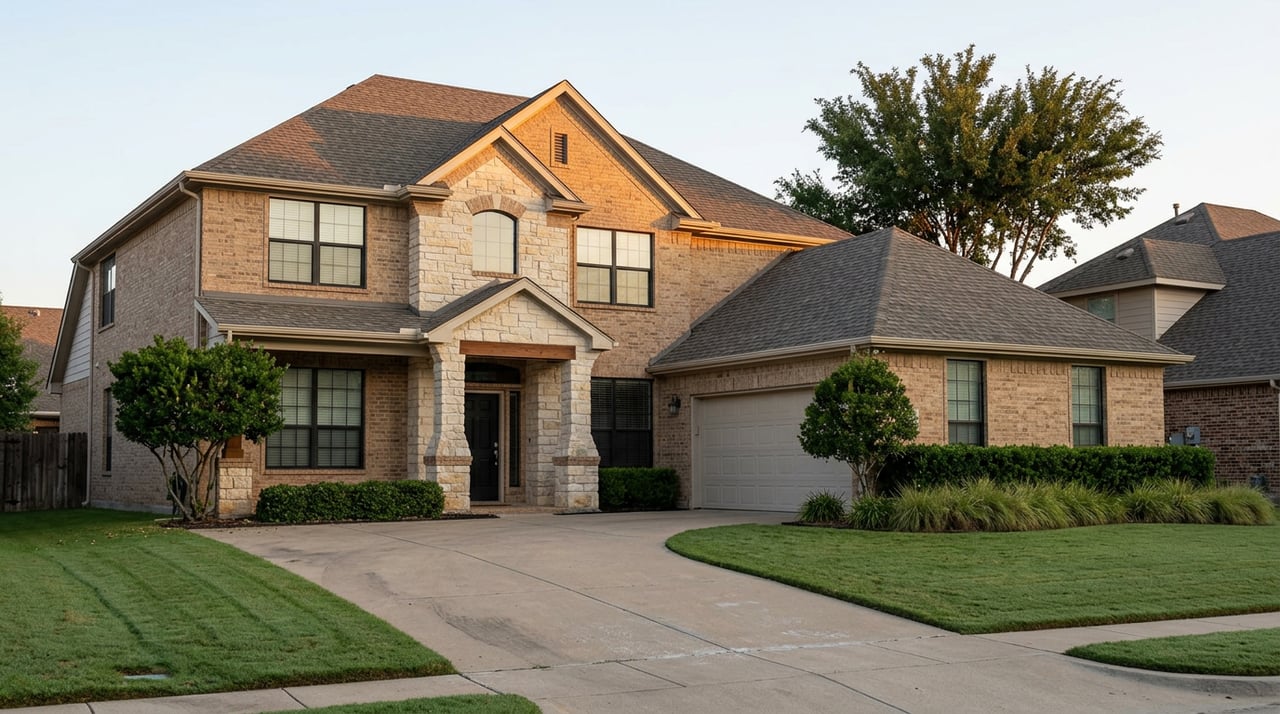
Two buyers walk into Midlothian this fall with the same $460,000 budget. One lands a home in Villages of Walnut Grove. The other buys in GoodLand, the sprawling master-planned community stretching along the southern edge of the city. Same price range, same school district, same closing month. Their monthly housing payments will not match, and the gap has nothing to do with the house itself.
It comes down to a line most buyers never think to ask about before they fall in love with a floor plan: whether the subdivision sits inside a Municipal Utility District, a Public Improvement District, or neither. That single distinction changes what shows up on the tax bill every year, and it changes what happens legally if nobody tells you about it until the contract is already signed.
The Base Rate Everyone Pays
Every Midlothian homeowner starts from the same foundation. Midlothian ISD accounts for the largest share of the property tax rate, at roughly 1.07 percent, with the City of Midlothian adding about 0.65 percent, Ellis County around 0.27 percent, and Navarro College another 0.11 percent. Combined, that puts the baseline tax rate near 2.10 percent of assessed value across the city, before anything specific to a subdivision gets added.
That base rate is not where new-construction buyers get surprised. It's public, it's consistent, and most builder sales offices quote it accurately. The surprise sits one layer down, in the taxing or assessment structure some communities carry on top of it.
Where the Bill Splits
Midlothian's new-home boom has produced two very different approaches to funding infrastructure, and builders market both as selling points, just in opposite directions.
GoodLand, the roughly 5,000-acre community south of the city built out by Beazer Homes, Highland Homes, David Weekley Homes, HistoryMaker Homes, and M/I Homes, has amenity centers, trails, and roads. A PID assessment is a fixed obligation tied to the lot, repaid over a set term, and separate from the ad valorem rate, as M/I Homes explains.
Other communities have built their marketing around avoiding that structure entirely. Bloomfield Homes advertises its Villages of Walnut Grove community specifically on the promise of low taxes without MUD or PID costs. Hawkins Meadows markets itself the same way, pointing to one of the lower property tax rates in the DFW metroplex as a selling point alongside its no-HOA structure.
Then there's the third category: land that was developed under an actual Municipal Utility District, which LegalClarity describes as a political subdivision with an elected board that issues bonds and sets its own tax rate every year. Ellis County is home to more than one of these. These aren't abstract categories on a builder's spec sheet. They're small governments that levy taxes the same way a city does, just for a much smaller and more specific footprint.
Here's how the three approaches compare on paper:
| Structure | Example | How it's billed | What it funds |
|---|---|---|---|
| Public Improvement District (PID) | — | Fixed assessment, separate from ad valorem tax | Roads, amenity centers, community infrastructure |
| No MUD or PID | Villages of Walnut Grove, Hawkins Meadows | Standard ad valorem rate only | Nothing beyond city, county, ISD, and college taxes |
| Municipal Utility District (MUD) | — | Separate ad valorem tax rate set annually by an elected board | Water, sewer, drainage bond debt and operations |
None of these structures is inherently the wrong choice. A PID or MUD often means amenities and infrastructure a buyer would otherwise pay for through a higher list price. The problem isn't the structure itself. It's buying a home without knowing which one you're in.
The Notice That Starts a Clock, or Doesn't
Texas law treats these two structures very differently when it comes to disclosure, and the difference matters more than most buyers realize until they're mid-contract.
If a property sits inside a MUD, the seller has to give the buyer a statutory notice before the buyer signs a binding contract, under Chapter 49 of the Texas Water Code. If that notice arrives late, the buyer generally gets a window to terminate after actually receiving it rather than losing that right the moment ink hits the contract.
If the property sits inside a PID instead, the rules got sharper in 2021. Sellers must now attach a specific TREC addendum, form 53-0, disclosing the obligation to pay improvement district assessments. Skip it, and the buyer can walk away from the deal at any point before closing, not just within a short window. The Texas Real Estate Commission has been explicit that this PID notice form is a seller disclosure responsibility, distinct from the older MUD notice paperwork, and the two forms are not interchangeable.
If the notice shows up after you've already signed, read the date on it before you assume the deal is locked. The clock on your right to walk away doesn't start when you sign. It starts when the notice does.
For buyers comparing a PID community against a MUD-governed subdivision, that's not a technicality. It's the difference between a seven-day window and an open-ended right to terminate if the paperwork gets missed.
The Other Surprise: Year One Isn't Year Two
Even in communities with no MUD or PID at all, new construction in Midlothian carries a separate timing trap that has nothing to do with special districts. This applies whether the lot sits in GoodLand, Villages of Walnut Grove, or anywhere else new construction is going up across Ellis County, so it's worth building the tax bill into a monthly payment plan from day one.
Five Questions Worth Asking Before You Sign
- Is this lot inside a MUD, a PID, both, or neither, and can the builder point to the specific district by name?
- If there's a PID, is the assessment structured as an annual installment or a payoff amount, and what's the remaining term?
- If there's a MUD, what is the current tax rate, and has the district's board lowered it in recent years as bonds get retired?
- What will the escrowed tax payment look like in year two once the home is fully appraised, not just the year-one estimate the builder quoted?
- Has the required notice, MUD or PID, actually been delivered and dated, or is it still pending?
None of these questions require a real estate license to ask. They just require knowing to ask them before the sales counter closes the file.
A Few Direct Answers
Does a MUD tax ever go away? Sometimes, but slowly. As a district's bonds get paid down and more homes join the tax base, some MUDs lower their rate over time. It's not something to count on within a normal ownership window.
Is a PID assessment the same as an HOA fee? No. A PID assessment is a fixed obligation tied to the lot itself.
Can I find out if a specific address is in a MUD before I make an offer? Yes. The Texas Commission on Environmental Quality maintains a public water district map viewer that lets you search by address.
Midlothian's new-construction market rewards buyers who ask about the taxing structure with the same seriousness they bring to square footage and lot size. The Angelique Burkett Team has spent years walking Ellis County buyers through exactly this comparison, community by community, before an offer ever goes in. If you're weighing GoodLand against Walnut Grove against something still under construction that hasn't hit the market yet, reach out before you sign anything. And if a Midlothian move means selling first, our team can put together a free home valuation so you know what you're working with on both ends of the transaction.
This article is general information, not legal, tax or financial advice. Consult a qualified professional about your situation.